Tuesday, 12 April 2016

Tower Ridge in winter

I had thought the winter season was over for another year, though like last year after having assumed that my ice axes and crampons would go away not to see the light of day for 9 months my assumption was proved wrong and I received a message from Joe asking if I was keen for a days winter climbing on Ben Nevis.

Having had a productive week and having made the decision a few months ago that I was always going to take Sundays off from coursework, I decided there wasn't a better way to spend a Sunday in April.

Myself and Joe made the now rather routine drive across the country without too much trouble (though he did miss the Dalwhinnie turning) the night before and we settled down at about 10 pm. I must admit I've grown rather fond of sleeping in Joe's car, I now associate the experience with a feeling of anticipation and while his car may be small it is more than large enough to accommodate my fully outstretched body.

The alarm was set for 4:30 am with the intention of being ready and walking by 5 am. Our winter walking fitness certainly showed and the walk-in that I'm usually a bit apprehensive about was finished in about an hour and a half. We thought we were moving very quickly until Masa Sakano: the only east asian (that I'm aware of) seriously involved in the Scottish winter climbing scene, ran past us with a full winter pack on. What a hero.

Scanning the north face of the Ben from outside the CIC hut we looked at the ice and buttress routes on the left side of observatory gully. The ice didn't look superb and it had a dusting of snow on the top, this coupled with the gargantuan cornices crowning North East Buttress put me off trying either of indicator wall or point 5 gully, our original two ideas for the day. The weather was superb though and we decided a day on one the the ridges in alpine conditions would be the optimal way to spend our time. Eventually we settled on doing Tower Ridge, simply because it was nearer than North East Buttress and Joe had done the route in summer so had a pretty good idea of where the line went.

Powering my way up the Douglas Gap east gully
I began the lead out of the Douglas gap at 7:30 in the morning. The first proper pitch was a tad bare and I discovered it was easier to climb with my gloved hands than to try and use my axes. The pitch went down quickly and soon myself and Joe were moving together over easier ground to the base of short steep ice pitch. This pitch once again fell to me to lead, I didn't have any screws as they were in Joe's bag but I placed a wire in a wall on the right beneath the ice before moving up. The ice was very picked out and hollow sounding. As I kicked my feet in a low drumming noise emanated from the ice. Despite this the ice was alright and the pitch added some fun to the day.
Joe had filters on and couldn't work out how to turn them off until later in the day.
Sunglasses? This can't be Scotland!
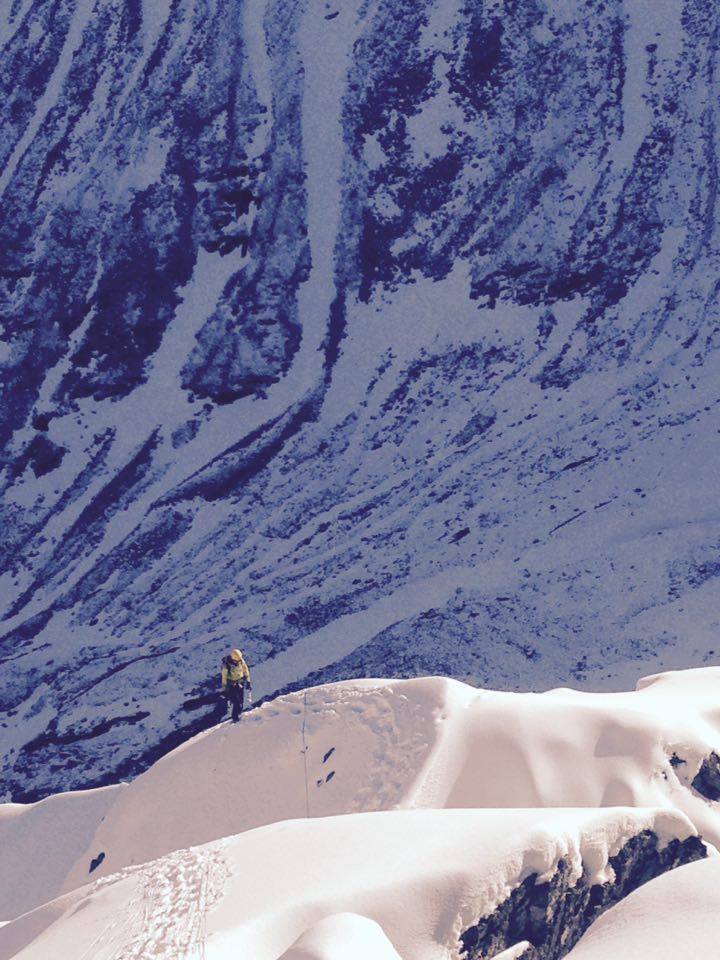
Above this we moved together a long way once again, going over one or two rocky steps before we belayed before the eastern traverse, one of the more famous sections of the climb. What makes it famous is the exposure. The climber must traverse easily leftwards without much protection, though there is plenty of air beneath the climbers feet. For all of it's reputation it is basically an easy plod across which you can almost get away with just walking. After the traverse Joe got to lead his first proper pitch of the route which took us up and over some easy mixed ground and back onto the crest of the ridge above. 

The Eastern Traverse, Intimidating but Easy
The final difficulty of the ridge is the famed "tower gap" which boils down to one awkward and intimidating move to drop down into a deep notch cut into the ridge at its narrowest point. In retrospect it's the only move on the route that really made me pause for thought. I was only just long enough for my feet to reach the bottom of the gap with my axes still on the lip. I discovered later that I didn't have to drop down and fully commit to my axes, instead there is an intermediate foothold that can be used if you can spot it, though I certainly couldn't. 

The Tower Gap after the cloud came in
After getting down into the gap, you then have to climb out on the other side, which is much simpler than getting into it in the first place. Soon both myself and Joe were on the other side and he headed off ahead as we moved together to make it up to the summit plateau.

We topped out on the ridge at 11 am having spent a mere three and a half hours tackling the ridge, not bad! Sadly the cloud had come in as we tackled the gap so it was no longer as clear as it had been in the morning, though short breaks in the cloud allowed us to admire the views. Most of the hills have now lost their winter coats, exchanging them for the warmer reds and greens of the mountain heathers and grasses. 

We descended from the summit via the tourist track and over the shoulder past Lochan Meall An T-Suidhe where we stopped to dip our feet in the baltic water before making it back to the car just before 2 in the afternoon. In retrospect we probably should have done North East Buttress after Tower Ridge, we certainly had enough time before the sun went down to fit it in. Though we still had a nice mid-spring days winter climbing on Ben Nevis Regardless.

Saturday, 26 March 2016

St Victoire - Southern Sunshine

About this time a year ago I was nominated to be the "international expedition officer" for the St Andrews Mountaineering Club, which is a rather poncy sounding title that basically just entails organising an international climbing trip. At first I had many grand ideas for cool locations, but sadly I had to be brought down to earth by various logistical concerns and my ambitions were curbed dramatically. In the end I settled on a week of sport climbing in the South of France, more specifically the not particularly well known destination of St Victoire. This mountain is probably better known to art historians than it is to climbers. Over the years true masters such as Cezanne, Picasso and Kandinsky have made the mountain their subject.

Mont St-Victoire and the viaduct of the Arc river valley - Paul Cezanne
The climbing on this mountain is primarily sport climbing, though frequently a light trad rack is required. Either because the bolts are spaced, or sometimes because they're not there at all! Another thing to note about the climbing here is from my (admittedly small) experience of sport climbing the grades were massive sandbags, this was exemplified perfectly by 5+ instead of being a grade I could climb with a blindfold became a bit of a battle depending on the circumstances. The first few days were a rather humbling experience, I didn't do particularly well partly because I was expecting the routes to be easier than they were and also because I was so out of practise having last climbed outdoors with my bare hands (and not axes and crampons) in September/October time last year. 

A typical St Vic route: slabby with spaced bolts
A lot of the days were spent doing not particularly note-worthy things. Though two routes did stand out far from the rest. I did a 17 pitch 5+, though it was more of a trad route really and equated to something like E1 5b in british grades. The other really stand out day for me was when I traversed along the top of St Victoire and took in the beautiful views over cote d'azur.

St Victoire in all of its splendour
The line of Le Grand Parcour weaves its way up the entire south face of the mountain and has two main sections, pitches 1-3 form the lower bulk of the route and are the only bolted ones, everything above relies on trad gear with the occasional peg to make things simpler. Though the pegs are so sparse if you planned on relying on them you'd be clipping one every 20 metres or so. The upper (and harder) hard section is taken up by pitches 13-17. In between these there are three pitches we deemed a rope to be necessary on (most notably pitch 9) then the rest are either solo-able or simul-climb-able.

The climb as a whole took two attempts to complete. This came down to expecting there to be more bolts above the first three pitches. I was anticipating being able to move faster than we were and once we'd passed the lower bolted section our progress was slower than I would have hoped and upon reaching the base of pitch 13 with only two hours of sunlight left whilst having not done the four hardest pitches (all trad) and the decent (which I didn't know) still to do. I made the call which turned out to be 100% correct to go down in the daylight.

Just before I decided we should go down
The day hadn't been a total waste though. The first three pitches, especially the first and third were absolutely sublime. Pitch one followed a line of nice shiny bolts through jug city. And then pitch 3 was a nice steep pitch with some delicate moves lower down and then some burly climbing up a groove which formed the crux higher up. After these we soloed quickly up the ridge to reach a long though fairly easy pitch up some ledge-y ground. We roped up for this pitch and then walked the next section to get to the base of pitch 9. Pitch 9 was the first challenging trad climbing pitch and on this day it was led by Denning. She made it up the 60 metres very smoothly, the pitch weaves catlike up some hold less slabs into a groove which goes the height of the outcropping to just beneath a large roof where a belay is made.

Me leading pitch 9 two days later
Pitch 10 is a bit of an odd pitch, the leader traverses under the roof then climbs easily upwards past the roof and then they double back on themselves before going up again. Meaning the leader traces a truncated "s" shape up the cliff, some imaginative rope management was required to safely protect the second with minimal rope-drag.

The pitches after this myself and Denning simul-climbed for maximum efficiency. Though as I mentioned earlier we were still not fast enough and we had to descend down some tree-filled gullies to get to the rough track that leads diagonally across the south face of the mountain, better known as the "Trace Noir".

Two days later myself and Denning returned for round 2 on the route. This time we opted to start from the Trace Noir which cuts the route at pitch 9 as we didn't have a full day to climb due to beginning our journey home that night. 

On the second time round I led pitch 9, which was a very enjoyable trad pitch and I reckoned weighed in at about HVS 5a. Once again we simul climbed the following pitches up the thin ridge to the base of the upper difficulties. These difficulties consist of a huge Y shaped chimney. Pitch 14 climbs the chimney before the fork and then pitch 15 (the routes crux) follows the left of the two forks, though if I ever come back I'd love to try the right fork as it looks mind-blowingly good and mega exposed!

Denning led pitch 14 smoothly up the awkward chimneys and was soon looking around for somewhere to set up a belay, unfortunately due to her lacking in stature somewhat she couldn't see the 3 pegs in the rock on the ledge just above her head, once I reached her I pointed this out to her and we had a good laugh about it as she'd (understandably) faffed for quite a while making her first ever fully trad anchor. So that she could be a bit more comfortable belaying me on the next pitch we did a very short pitch (probably about 3 metres long) to get to the pegs and make everything a bit comfier.

Myself getting involved in the awkward chimney.
The next pitch was the crux of the route and I'd decided I'd go for the lead. It was a great pitch, if a little short-lived. The difficulties were the first cluster of moves leaving the belay which at first were a bit perplexing but with a little re-arrangement I soon found myself firmly jammed in the chimney above the challenges. A few more exposed moves above a couple of good cams lead to a ledge and a nice bolted belay station. 

Getting myself jammed into the offwidth chimney for added security
After this a couple of steep pulls on good flakes were all that separated us from the easy pitches to the top. Soon these were dispatched and we were un-roping at the top of the mountain!

Me leading the final pitch - taken by Natascha
Coiling ropes like a ballerina.
As we reached the top, Georgiy came over the ridge. They'd planned to do the whole route in a day though realised they wouldn't have enough time same as us two days previously. Instead of carrying on once they reached the Trace Noir he and Natascha decided to walk up the Trace Noir and visit the Croix de Provence: The 20 metre tall cross perched atop St Victoire. Due to a lack of time to catch the bus back to the campsite, after a very brief break we were back on the move again descending the Trace Noir. To reach the descent we had to escape down through the really cool limestone cave/tunnel called the "tunnel du Garagai" 

The "Tunnel du Garagai"
The two things I was most stoked on about this route were:

1) Being able to climb a summer mountain trad route for the first time in ages,  
    there's just such a unique feeling you get from climbing in the mountains in 
    summer and I was really growing to miss it.

2) Knowing that next year after Joe and a large chunk of the most prolific               climbers at the club leave, there'll still be a solid climbing partner with
    bottomless stoke to go out and get on some amazing trad lines around
    Scotland with me! Thanks Denning!

Infectious Stoke
The second really special day was for me a day spent walking! I can see you all spitting out your coffee, is Caelan really admitting to enjoying a walk? It would seem so! The traverse of the ridge of St Victoire was a really stellar experience and maybe my favourite individual day of the whole trip!

The day began with me leaving the campsite I chose not to take the bus, instead opting to walk the whole way. The sun was blazing, I had a light pack with only some food, water, sun cream and my bible which I planned to read whilst sat eating my lunch under the Croix de Provence admiring the views of the French Riviera. 

Finding the line up to the mountain amongst all of the snaking paths around the refuge Cezanne proved to be quite challenging, and some awkward conversations with french people who didn't speak any English ensued. After a lot of unavoidable confusion I found myself atop the ridge following a solid looking path up to the cross. Before the cross was reached however I found myself in a small notch in the cliffs. Contained within this notch was a small catholic chapel and a cluster of out buildings, one of which had been re-purposed to form a refuge (I think that's what the sign said!). A couple of pine trees grew, and if it hadn't been for the large numbers of people it would have been a beautifully cool and peaceful spot tucked away from the heat of the midday sun.

Looking down at the little enclave.
Not wanting to get caught behind a large bunch of rowdy french walkers, I left just before they did and raced up the path to reach the cross before they arrived. From the foot of the cross you could see to the Alps in the north west to the Mediterranean in the south. Absolutely incredible views! I dug my bible out of my bag and read a few verses from the psalms:

96 Oh sing to the Lord a new song;
    sing to the Lord, all the earth!
Sing to the Lord, bless his name;
    tell of his salvation from day to day.
Declare his glory among the nations,
    his marvellous works among all the peoples!
For great is the Lord, and greatly to be praised;
    he is to be feared above all gods.
For all the gods of the peoples are worthless idols,
    but the Lord made the heavens.
Splendour and majesty are before him;
    strength and beauty are in his sanctuary.
Ascribe to the Lord, O families of the peoples,
    ascribe to the Lord glory and strength!
Ascribe to the Lord the glory due his name;
    bring an offering, and come into his courts!
Worship the Lord in the splendor of holiness;[a]
    tremble before him, all the earth!
10 Say among the nations, “The Lord reigns!
    Yes, the world is established; it shall never be moved;
    he will judge the peoples with equity.”
11 Let the heavens be glad, and let the earth rejoice;
    let the sea roar, and all that fills it;
12     let the field exult, and everything in it!
Then shall all the trees of the forest sing for joy
13     before the Lord, for he comes,
    for he comes to judge the earth.
He will judge the world in righteousness,
    and the peoples in his faithfulness.
After about 45 minutes sat beneath the cross I got up and continued the walk along the ridge, taking a multitude of pictures of it. Whilst I may not agree with every nuance of catholic theology I think we can all agree that they know the most dramatic places to erect a cross:

The awe inspiring Croix de Provence - 18.25 metres from top to bottom

You can see the cross from Aix en Provence: 10 miles away!
After this the walk was simply an enjoyable romp in the sunshine along the top of this most beautiful of mountains. If you're ever in the area and aren't up to the climbing on the mountains south face I can't recommend this walk highly enough! The walk ended up taking me much longer than I expected, about 6 hours from camp site to the bus stop at puyloubier at the other end of the mountain ridge. As you get further from the summit of the mountain (which is actually a few hundred metres beyond the Croix de Provence) the ridge gets less and less striking, though is still beautiful and has the added bonus of having less traffic on it.

Looking east.
All in all, I'm very happy with how the organisation of the trip went especially considering this was my only my second time flying (my first time in 4 years) and my first ever abroad climbing trip. At the end of the day (though it wasn't perfect) it could've been a lot worse. The only real downers for me where not being able to make it to the verdon gorge for a myriad of factors (though it later snowed there, so it wasn't much of a loss in the end), The other huge downer was that the morning of our flights back to blighty was the same morning as the bombs in Brussels. I have some thoughts about this (as do we all) but this blog isn't really the place for them.

My next (slightly) international adventure takes me to the sun baked Northern Ireland (haha.) for the Fairhead meet with the legend that is Ben Gibson: Roll on June!

Wednesday, 2 March 2016

Winter Warmer

having hit honours this past year in my maths degree as part of my degree I'm required to go and visit a big posh house called "The Burn" where we sit and talk about maths all weekend and prepare a talk on mathematics to present to our professors. This action packed weekend is only undertaken by penultimate year students, due to my entry to honours being a year early I wasn't required to go to "The Burn" along with my course-mates. Instead I was effectively handed a 4 day weekend without classes or tutorials! Any self respecting climber in this situation knows exactly what to fill empty days in winter with. The forecast looked promising and Joe was free, so with Erik in tow the three of us began the four hour drive from St Andrews to Torridon to attempt the ultra classic Poacher's Fall

We arrived in the Liathach car park in the dark and quickly hunkered down in preparation for our 4:30am wake up. We grumpily arose and I stuffed  some fruitloaf in my mouth before beginning the plod round the back of Liathach. For some reason I had it in my head that the walk into Liathach was going to be really hard work. On the contrary it was one of the easiest winter walk ins I've ever had, there is almost no uphill and on the day a trail through the snow had already been broken making my life noticeably easier. Soon we were in the relevant corrie and able to see the fat line of Poacher's fall looming in the distance.


Poachers is the central streak of ice.
We quickly trudged up the steeper snow to find a large flat area had been dug into the snow beneath the route the day previously where we opted to gear up. I'd said the day before that I was happy to lead any pitch on the route as I was just keen to lead some ice this season because after the rather poor start I'd just kind of come to expect that ice wasn't going to materialise. As a result I was given the first of three pitches. 


The first moves
I swam up some deep snow to the base of the ice. I swung my axe for the first time and to great joy discovered that the ice was just perfect. All it took was one swing and the placement was bombproof. I swung with my other axe into even more glory ice. Soon, without really realising due to just being distracted by how good the ice was I was way above the deck without any gear. Joe reminded me to place some screws and so I did before carrying on up. My goal was a cave about 60 metres up where there was some in situ abalaklov thread belays.


Just beneath the cave
At about the 30 metre mark the pitch began to steepen and I had so be more methodical about my movements and my gear placements, though the ice was still incredible and I rarely required more than one swing to get a bomber pick placement. Having aimed for the cave I'd actually accidentally climbed passed the in situ belay point, having realised this I had to down climb a short section to get across to the threads. I quickly set up the belay and shortly both Erik and Joe where at the belay with me. Because we were climbing as a three and we each wanted a pitch, a small amount of faff with the ropes ensued before Joe could head on up and tackle the next pitch: the crux of the climb.


Joe leading, just before he disappeared from sight
as is to be expected from Joe on the crux of the route there was a fair number of watch me's heard coming from above. Though the constant updates were appreciated as pretty soon into his pitch he disappeared from our sights and the only feedback we had from the leader was the occasional jaunt on the rope and the stream of "watch me" coming from above.

The crux of the route was a short corner of very steep ice, due to your ice axes pushing you back from the ice it felt like the ice was overhanging, though it was over quickly and some some sustained grade IV ice from there lead to the belay at the top of the pitch.

The final pitch of the route follows a long winding runnel of grade IV ice to the bottom of the snowy slopes on the main Liathach ridge. Erik climbed very quickly, placing screws with speed and was shortly at the snow slopes where another abalaklov thread belay loomed.


Erik heading up into the icy chimney

too good to be true!
Once we'd reached Erik we launched up the snow slopes so that we could reach the top of Liathach and eat our lunch on the top. The higher up the mountain we got the further around we could see until we reached the summit from where we could see for miles in all directions. Truly one of the best winter climbing views I've ever had.


On the approach to the summit
I sat on the summit cairn, eating pizza enjoying the beauty of Scotland around me. The climb had been unbelievably good, there was no single good pitch. All of the pitches were as good as each other and each pitch was of the highest calibre of climbing that we have in Scottish winter. The views from the summit really capped things off. We sat peacefully on the windless summit until we felt we could linger no more and began our descent.

Now the descent turned into a bit of an adventure, we walked along the ridge to the east, though we soon realised that the snow on the bulk of the mountain was quite dodgy. After some short discussion we decided to abseil down a large easy angled gully on the south side of the mountain. Thankfully this passed without too much drama though walking on snow you don't really trust is always a bit nerve racking. I was definitely glad for the rope. A couple of steeper sections split the gully and the ice on these was very poor and de-laminated whilst I was being lowered down by Erik and Joe. This was worrying to say the least and once again I was very grateful for the rope.

Soon we'd made it down to the bottom of the gully and beneath the snow line. Looking back at the south face of the mountain our caution had been warranted as much avalanche debris littered it's slopes. A short walk along the road took us back to the car park, we sat in the car for a short while eating food before we drove back south east to the Cairngorms in preparation for another days climbing.

The next day we knew that the northern corries would fill very quickly due to it being a weekend and that the weather forecast was spectacular, we opted for the early start to try and beat the crowds in. Thankfully this strategy payed off, and when we got to the bottom of fingers ridge (more like "fun"gers ridge). There was only one other party on it ahead of us.

The majority of the corrie was very heavily rimed and most of the routes looked like they'd be an unpleasant swim given the conditions. However due to the popularity of fingers ridge a groove up through the rime had been dug out and the climbing wasn't affected by the rime because of it, which made the climb a much more enjoyable experience. We climbed in 2 pairs, I was with Erik and Joe climbed with Paul. Myself and Erik set off first as Erik had the camera and would be able to take pictures of Joe leading from above. Erik got the first pitch of the climb which mainly involved climbing up on good snow and not much to sustain interest. Though soon he'd climbed the 60 metres of the first pitch and was belaying up above.

I quickly made it to where he was, and after a small break to cool down (it was unbelievably warm in the sun) I set off on the next pitch. The climbing on the second pitch was continuously fun and very interesting, with fantastic gear whenever you felt like you needed it. At first I was gutted not to have been able to lead the iconic fingers pitch, but after pitch 2 I felt like I hadn't missed out on anything, as it was just as good if not better than the climbing on pitch three.

Joe beneath us, leading pitch 2

Myself on the lead of pitch 2
Erik lead through on pitch three which we'd wrangled to be the final pitch of the climb. Erik threaded between the needles and was soon out sight. Behind the fingers was a short sharp wall, which was thin on the feet and required the ability to torque your axes well into thin cracks. Thankfully though the feet weren't mega the torques were about as good as they come. I felt like I should've been on a harder route than I was because of how thin and techy it all felt, right up my street! Erik made it past this wall by beached whaling onto the top which always adds some comedy value to a route. 

The classic shot
On my own way up I'd decided I wanted to stand on top of one of the fingers, which proved to be of the most trouser filling experiences I've ever put myself through. I discovered the wider of the two fingers was much harder to stand on top of, and so I had to stand on the narrower one, which was about the size of a place mat. I stood there and pretended like I wasn't scared and hoped that the pictures would be worth it. I was very jittery afterwards, much to my own amusement.

I needed new undies after this one.
The day ended by relaxing on the cairngorm plateau with good friends in glorious sunshine, what better way to spend an afternoon?

Great times.

Lots of people enjoying the weather


Monday, 8 February 2016

Douglas Bouldering

As naming things goes the Douglas "Boulder" is about the biggest misnomer within the scottish winter climbing scene. This supposed "Boulder" is as large as most of the rest of the big mountain crags in the country, but given its surroundings it pales into comparison to the gargantuan Orion face, Carn Dearg Buttress and some of the longest mountain ridges in the country.

The Douglas Boulder in its natural habitat almost always passes under (or over) the noses of most climbers on the Ben who prefer to keep on slogging to one of the classic ridges or any one of the routes up observatory gully. The only time people seem to climb on it is if they're pretty strong and want to test their skills against hard mixed classics like cutlass, or if the weather is more akin to the inside of a jet engine than any weather one might experience on the commute to work.

The atrocious weather in Scotland is something I'm surprisingly rather fond of. More surprising still is that I don't appear to be the only one. Over the course of a winter in Scotland, hundreds of international climbers will make the trip to our little island to test their mettle against our comparatively small mountains. On both occasions I've stayed in the CIC hut I've encountered European climbers who've exchanged the Alps with their stable weather and shiny bolts for some of the worst weather in the world people will actually climb in and a noticeable lack of any decent protection. Whilst I may question their (and my own sanity) for making this decision it definitely instils Scottish pride in myself! 


The classic bad winter weather shot; Credit to Nick Carter http://www.ukclimbing.com/images/dbpage.html?id=87093
This past weekend the weather was up their with some of the worst I've had whilst in Scotland in winter, and fell firmly in the second category of people who climb on the Douglas Boulder. Though it was still a fantastic weekend  for many reasons; first we got to skip the first (and worst) section of the walk in to the CIC as a friend of Erik's had a key for the gate second my confidence was boosted a lot in my ability to stay safe in the hills in winter and my abilities when it actually comes to mixed climbing.

Apparently myself and Joe are early birds for climbing, we were more than happy to wake up nearly an hour before what people deemed to be reasonable. An early start soon found us out of the doors of the CIC and into the marginally nicer weather in the morning. The winds were lashing the snow and ice around biting away at any exposed skin. Myself and Joe forced our way up into observatory gully to go and have a peek at the Indicator Wall area. After entering observatory gully and realising the snow was waist deep in many patches we soon lost our motivation to head all the way to its top and instead opted to check out point 5. From far below point 5 actually looked alright, there was definitely some good ice, the sight of this coaxed us ever higher. as we got nearer and nearer I grew less and less sure point 5 was a good idea, every 2 minutes gargantuan quantities of spindrift would pile down the narrow gully from above. To climb it like this would not only be a horrifically unpleasant experience but would likely be downright dangerous, not being able to see the snowy bowl above the gully we had no idea whether the spindrift would get any more serious or whether anything else was likely to come down with the snow. After a brief discussion we decided that point 5 could wait and left the gully in the company of a group of climbers from London. I'd certainly rather them than me in the state it was in.

Joe suggested trying a mixed route on the Douglas Boulder as none of the lower down Ice routes were in good nick. This seemed a good idea and we began the plod back down observatory gully. We met many climbers on the way down who asked why we were walking in the opposite direction, we told them about the depth of snow and lack of good ice and most of them turned around and followed us too. After a quick traverse of the Douglas Gap we found our way at the bottom of the south west ridge of the douglas boulder; our climb for the day.


Joe at the bottom of west gully
We alt lead the route, with Joe taking the first lead, the hooks were great and the gear was even better! It turned out to be a really fun climb. You could really pick and mix your line to squeeze the most fun out of the ridge, at various stages I was torqueing both my axes in thin cracks just to make things harder (and funner) for myself. 

On my pitch I lead through a corner with sinker hooks and then wanting to make things fun for myself opted to lead through the steep cracked wall directly above. Some powerful moves lead me to a good rest on fantastic hooks behind a chockstone. Upon attacking the blocky wall above this I discovered most of the microwave sized blocks weren't stuck in place and instead moved a substantial amount, after a bit of sketching around to find safer placements I was above the choss and at the belay. The weather was starting to worsen and the winds were definitely picking up as I brought Joe up


Joe seconding the south west ridge
Above this was the top of the Douglas Boulder and from here we abseiled down into the Douglas gap beneath which was more akin to a wind tunnel than anything else. The short abseil down into the gap was one of the most tortuous I've had the pleasure of doing, once in the gap itself I didn't want to stay in the wind any longer than I had to and pretty quickly was down-climbing the gully to the comparative shelter of the west side of the Douglas Boulder. From here a short plod lead us back to the CIC hut. We arrived at some time between 2 and 3 in the afternoon. A rather short day, but an enjoyable one nonetheless. We sat in the hut for the rest of the day waiting patiently for the other 3 parties to return. One on CMD arete, another on Tower Ridge and the third on Tower Face of the Comb. 

abseiling into the Douglas gap
The weather forecast was to be about the same if not worse on the Sunday, as a result we felt another short day was in order and opted to climb Jacknife on the Douglas Boulder on the Sunday. This would be a step up in difficulty for both of us, both in terms of objective and technical grades. Though having become frustrated with the lack of thought required to climb most grade IV's I was really looking forward to the challenge.

The next morning we woke slightly later and watched a pair of seasoned climbers begin their progress towards leaving the hut. The first of the pair soon left and within seconds was back in hut again telling his partner to stay put as "it's a maelstrom out there". A maelstrom was certainly the right word, after a bit of dilly dallying they were on their way into the storm and we soon followed behind them with Merlin and Peter in tow. We soon reached the base of the Douglas Boulder and another 10 minutes of walking lead us to the base of the climb. A little indecisiveness cost us some time before we decided on what would be the best way to approach the climb. Our final decision transpired to be the wrong one, and soon Joe was leading his way up a horrible choss pile, the turf hadn't frozen making it even more unpleasant. Once at the top Joe spent more time trying to construct a sound belay amongst the choss than he had actually leading the lower pitch.


The next and crux pitch was all mine! despite the grade of the route being harder than anything I'd previously done I didn't feel so intimidated, The climbing didn't look so hard and I fel quietly confident. Soon I was at the base of the crux, I placed some gear before I headed up and shortly was getting myself involved with the corner. The corner itself had some slushy snow in its back which wasn't particularly useful as it didn't hold in place. The climbing was a tad awkward as there wasn't much for my right food, though the left feet were great and the hooks were too. Also in the bargain was a tonne of gear! Soon I was past the short sharp lower corner and romping up to the finish of the pitch. It had been exactly as I'd expected, a bit awkward but completely manageable, both myself and Joe's confidence was bolstered for when it comes to tackling harder climbs in winter. Next on the list Gargoyle Wall!